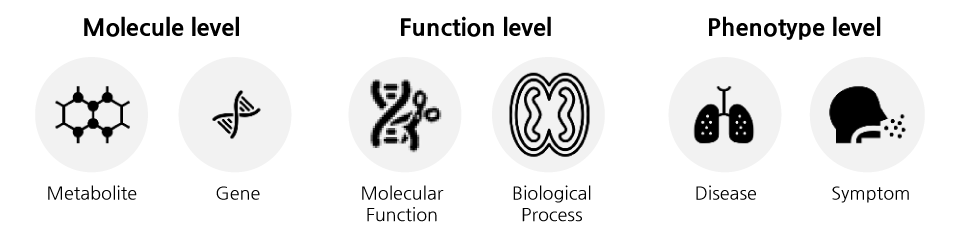
CODA (Context-Oriented Directed Associations) is an integrative system of biological knowledge for analysis of drug effects. Biological events occurring between biological entities are extracted and then converted to a standard language format so that they are unified into the CODA system. The biological events are collected from diverse resources such as public or private databases, scientific literature, in-house or public experimental data. The CODA system covers various biological entities including genes/proteins, metabolites, biological processes, molecular functions, diseases, symptoms. In addition, the CODA system contains diverse types of biological relationships between those entities, including molecule-molecule, molecule-function, molecule-phenotype, function-function, function-phenotype, phenotype-phenotype relations.
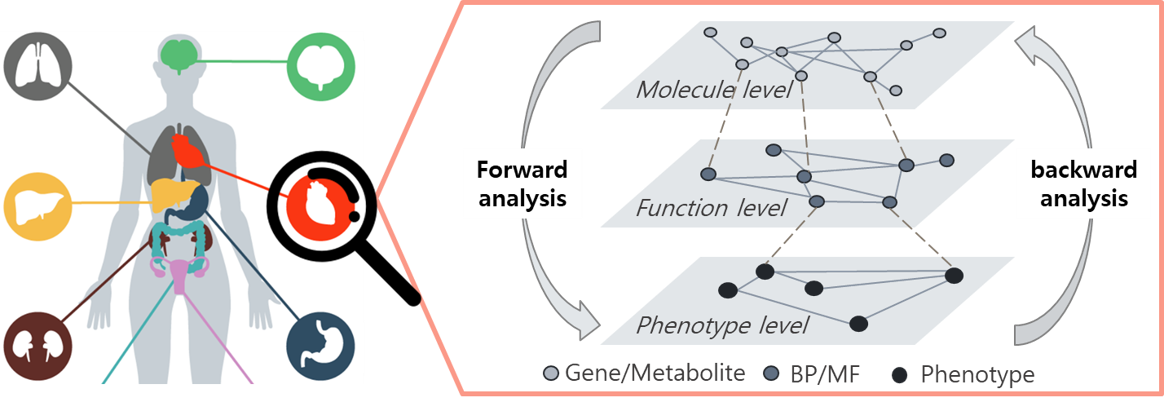
The CODA system can be represented as a biological network, called CODA network, in which nodes are biological entities and edges are relationships between nodes. The CODA network is the layout of three levels: molecule level, function level, and phenotype level. The molecule level contains genes/proteins and metabolites, and the function level contains biological processes and molecular functions, and the phenotype level contains diseases and symptoms. This layout facilitates three essential analysis in a pharmacodynamics aspect. The first is the forward analysis how molecular changes affect functional changes and, further, phenotypic changes. The second is the backward analysis what molecules abnormal phenotypes are affected by. The third is the mechanisms analysis what paths are connecting two biological entities (e.g. from drug target to target phenotype, or from disease gene to target phenotype).
The CODA system deal with essential biological information of biological events, especially biological contexts such as anatomical contexts and environmental contexts. Consideration of biological contexts facilitates distinguishing events that change depending on the contexts. Anatomical contexts, referring to where biological events are observed, are organized in a hierarchy. Each organ is comprised of tissues, and each tissue is comprised of cells. A biological event may take part between entities with the same anatomical context, as well as entities with different anatomical contexts. Therefore, the CODA system contains inter-anatomy relations as well as intra-anatomy relations, enabling whole body simulation necessary for analyzing complex disease mechanisms or multi-organ-related drug mechanisms. On the other hand, environmental contexts refer to when biological events happen (e.g. diseases, drug treatments). Therefore, the CODA system can differentiate biological events that are specifically observed in the certain environmental contexts.
CODA represents biological knowledge, interactions between two biological entities, along with anatomical or clinical contexts in which the knowledge is valid. Anatomical contexts represent organs, tissues, or cells in which interactions take place. CODA network contains intercellular associations as well as organ-specific intracellular associations so that diseases related to multiple organs such as hypertension can be analyzed. Phenomenon contexts represent conditions such as drug treatments or disease states in which the interactions occur.
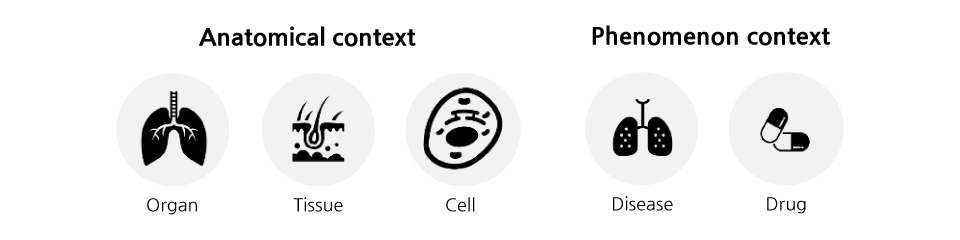
CODA represents not only molecule level entities, but also phenomic level entities as nodes. Phenomic levels includes function level (i.e. biological process and molecular function) and phenotype level (i.e. disease and symptom). This enables us to apply network analysis for analysis of drug effects to diseases as well as their mechanisms.